Water, Mangoes and Cashews: Unlocking Jobs Across Côte d’Ivoire’s Agricultural Value Chains
Mango and cashew are not just crops. With the right water systems, they can become multi-billion dollar industries and major job creators.
5/8/20243 min read
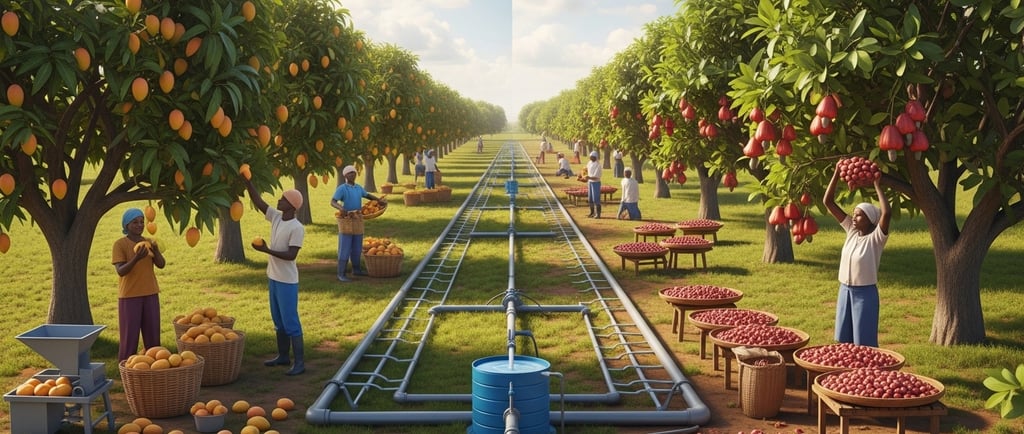
In Côte d’Ivoire, mango and cashew are more than agricultural products. They are strategic economic sectors with the potential to generate hundreds of thousands of jobs. Yet, one critical factor continues to limit their full potential: reliable access to water.
As global demand for agricultural products continues to rise, Côte d’Ivoire is uniquely positioned to become a leading agro-industrial hub in West Africa. The country is already the world’s largest producer of raw cashew nuts, with annual production exceeding 1 million tons, and ranks among the top mango producers in the region.
However, much of this potential remains underexploited due to structural constraints, particularly the dependence on rainfall.
Water as the foundation of productivity and job creation
In both the mango and cashew sectors, production is still largely rain-fed. This creates seasonal limitations, inconsistent yields, and vulnerability to climate variability.
Expanding access to irrigation could transform these sectors. Studies and field data show that irrigation can increase agricultural yields by up to 2 to 3 times, while improving product quality and enabling multiple harvest cycles.
More importantly, improved water systems could drive employment at scale. In Côte d’Ivoire alone, strengthening irrigation and water management across key agricultural zones could support the creation of hundreds of thousands of additional jobs by 2030, particularly in rural areas.
A value chain with massive employment potential
The real strength of the mango and cashew sectors lies in their full value chain. Job creation does not stop at farming. It extends across multiple layers of economic activity.
At the production level, millions of smallholder farmers depend on these crops for their livelihoods. The cashew sector alone involves over 1 million people, including farmers, laborers, and local traders.
In transport and logistics, jobs are created through the collection, storage, and movement of raw products from rural areas to processing centers and ports.
In processing, the opportunity is even greater. Currently, Côte d’Ivoire processes only a portion of its cashew production locally, although progress has been made in recent years. Increasing local processing capacity could generate tens of thousands of industrial jobs, particularly for youth and women.
In the mango sector, improved cold chain systems and processing facilities could reduce post-harvest losses, which can reach up to 30 to 40 percent in some regions, while creating new opportunities in packaging, transformation, and distribution.
Finally, in marketing and export, these sectors connect Côte d’Ivoire to international markets across Europe, Asia, and the Middle East. Strengthening branding, quality standards, and export logistics can further expand job creation in trade, business development, and international distribution.
From raw production to agro-industrial power
The key challenge is not production alone, but value creation.
Today, a large share of cashew nuts is exported raw, meaning that a significant portion of the value and jobs is captured outside the country. By investing in water infrastructure, Côte d’Ivoire can stabilize production and attract more agro-industrial investments.
Countries such as Vietnam and India have demonstrated how processing can transform the cashew sector into a major source of employment and export revenue. Côte d’Ivoire has the potential to follow a similar path.
Water investment as a strategic economic decision
Investing in irrigation, water storage, and efficient water management systems is not just an agricultural necessity. It is a strategic economic choice.
Reliable water access enables:
higher productivity
better quality products
year-round production
increased investor confidence
It also creates the conditions for scaling entire value chains, from farms to factories to global markets.
A clear path forward
With the right investments, Côte d’Ivoire could position itself as a leading agro-industrial economy in Africa.
Water will play a central role in this transformation.
By securing water access in key production regions, the country can:
increase agricultural output
reduce losses
expand processing capacity
and create hundreds of thousands of sustainable jobs
Conclusion
Mango and cashew are not just crops. They are engines of economic opportunity.
But without water, their potential remains limited.
With water, they can power a new era of growth, industrialization, and job creation in Côte d’Ivoire.
Author: Kouyo Elisabeth Keturah, CEO, K.Agriculture Media
Hashtags: #Agriculture #Africa #CotedIvoire #Cashew #Mango #AgriBusiness #WaterSecurity #Irrigation #FoodSecurity #JobCreation #AgroIndustry #Export #EconomicGrowth #ValueChains